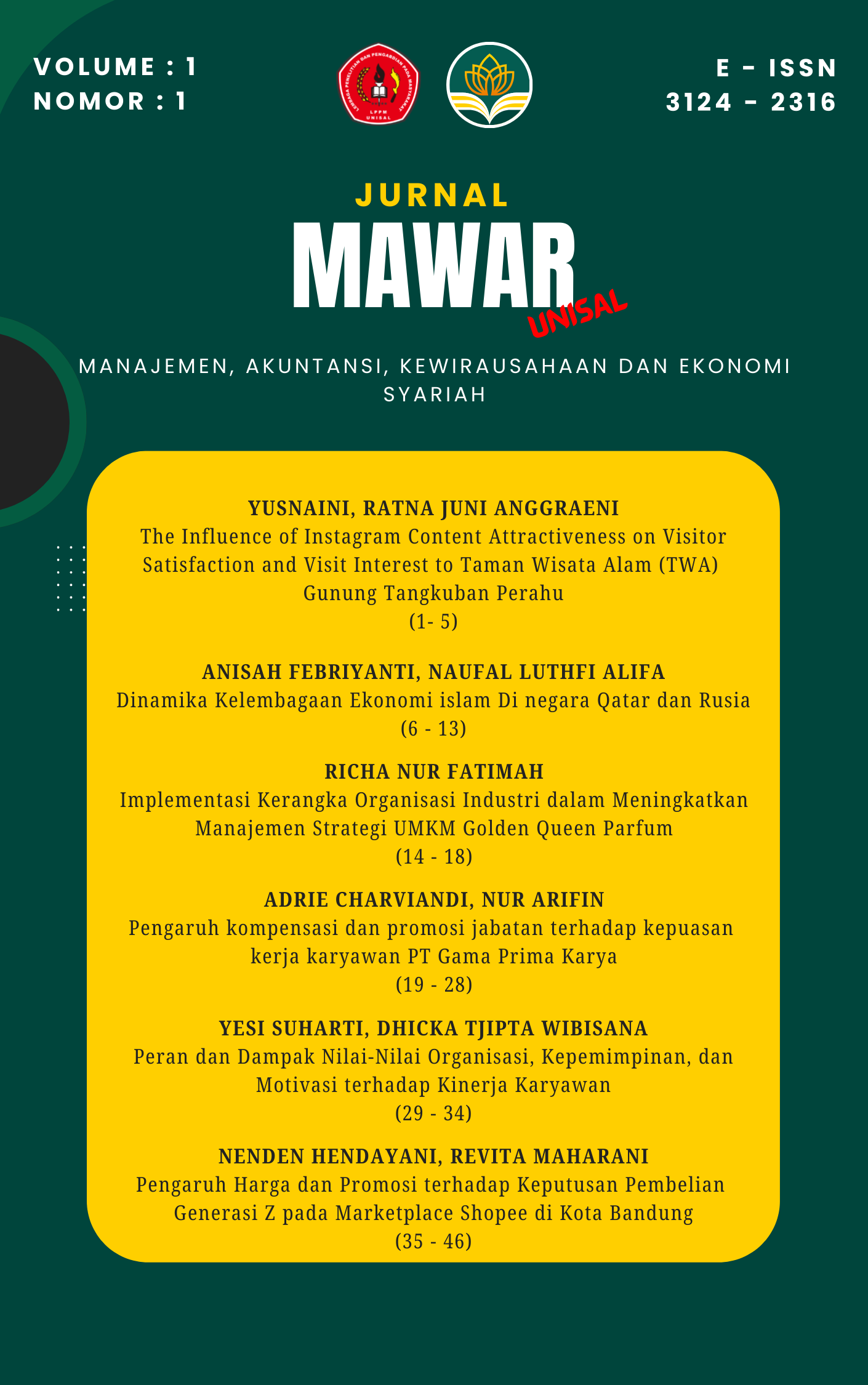
Dinamika Kelembagaan Ekonomi islam Di negara Qatar dan Rusia
Article Sidebar
Main Article Content
Abstract
The dynamics of Islamic economic institutions in Qatar and Russia demonstrate how a sharia-based economic framework is capable of adjusting to a wide variety of social, political, and economic environments, while still maintaining its core principles of justice, transparency, and ethical financial practices. In Qatar, the development of Islamic economic institutions has progressed rapidly due to strong political will, consistent economic stability, and a national vision that prioritizes diversification and international integration. The government actively supports Islamic finance through modern, clear, and comprehensive regulations that ensure compatibility with global financial standards, allowing Islamic banks and non-bank financial institutions to operate competitively both domestically and internationally. Qatar’s commitment to becoming a regional hub for Islamic finance is also reflected in the establishment of sophisticated financial infrastructures, research centers, and policy frameworks that encourage innovation while maintaining adherence to sharia principles. Meanwhile, in Russia, the evolution of Islamic economic institutions is more gradual and localized, primarily taking place in regions such as the Republic of Tatarstan, where cultural and demographic realities naturally support the growth of Islamic finance. Although Russia’s national regulatory environment has not fully accommodated Islamic financial products, increasing interest from both regional governments and economic actors has created momentum for gradual expansion. Pilot projects, partnerships with international Islamic financial institutions, and growing awareness among Russia’s Muslim communities indicate that Islamic economics is beginning to gain traction despite systemic challenges. Differences in political systems, cultural settings, and economic structures between Qatar and Russia shape the unique pathways through which Islamic economic institutions develop in each country. Overall, these dynamics reflect sincere and continuous efforts to present Islamic economics as a viable, ethical, and sustainable alternative capable of addressing modern economic demands while remaining firmly grounded in sharia values
Article Details

This work is licensed under a Creative Commons Attribution 4.0 International License.
References
Al-Haidous, S., Al-Breiki, M., Bicer, Y., & Al-Ansari, T. (2022). Evaluating LNG supply chain resilience using SWOT analysis: The case of Qatar. Energies, 15(1), 79. https://doi.org/10.3390/en15010079
Al-Sulaiti, A., Hamouda, A. M., Al-Yafei, H., & Abdella, G. M. (2024). Innovation-based strategic roadmap for economic sustainability and diversity in hydrocarbon-driven economies: The Qatar perspective. Sustainability, 16(9), 3770. https://doi.org/10.3390/su16093770
Al-Sulaiti, K., Al-Emadi, A., & Truby, J. (2024). Governance challenges in Islamic financial institutions in Qatar: Integrating Shariah compliance and sustainability. Journal of Islamic Accounting and Business Research, 15(3), 312–329. https://doi.org/10.1108/JIABR-04-2023-0121
Beck, T., Demirgüç-Kunt, A., & Merrouche, O. (2013). Islamic vs. conventional banking: Business model, efficiency, and stability. Journal of Banking & Finance, 37(2), 433–447. https://doi.org/10.1016/j.jbankfin.2012.09.016
Djankov, S. (2023). State capitalism in Russia revisited. Comparative Economic Studies, 65(2), 198–212. https://doi.org/10.1057/s41294-023-00200-2
Ibrahim, I. A., & Truby, J. (2022). Governance in the era of Blockchain technology in Qatar: A roadmap and a manual for Trade Finance. Journal of Banking Regulation, 23(4), 419–438. https://doi.org/10.1057/s41261-021-00165-1
International Monetary Fund. (2024). Qatar: 2024 Article IV Consultation Report. Washington, DC: IMF. https://doi.org/10.5089/9798400250229.002
Islamic Financial Services Board (IFSB). (2023). IFSI Stability Report 2023. https://www.ifsb.org/wp-content/uploads/2023/10/Islamic-Financial-Services-Industry-Stability-Report-2023_En.pdf
Javeline, D. (2024). Russia in a changing climate. Wiley Interdisciplinary Reviews: Climate Change. https://doi.org/10.1002/wcc.872
Khan, T., & Bhatti, M. I. (2008). Islamic banking and finance: On its way to globalization. Managerial Finance, 34(10), 708–725. https://doi.org/10.1108/03074350810891029
Klishevich, D., & Panibratov, A. (2024). The omnipresence of the state and its effect on the internationalization of companies: The Russian variety of state capitalism. Journal of International Management, 30(4). https://doi.org/10.1016/j.intman.2024.101154
Kularatne, C., Miyajima, K., & Muir, D. (2024). Estimating the Growth Impact of Economic Transformation in Qatar. Review of Middle East Economics and Finance, 20(3). https://doi.org/10.1515/rmeef-2024-0011
Makarenko, A. (2023). Islamic banking and finance in Russia. SSRN. http://dx.doi.org/10.2139/ssrn.4465021
Makarenko, V. (2023). Islamic banking development in Russia: Legal and institutional perspectives. Review of Central and East European Law, 48(4), 512–537. https://doi.org/10.1163/15730352-bja10122
Nagayev, R., & Jahangir, R. (2022). Islamic finance in Central Asia and Russia (Research Report). Research Center Islamic Economics – IKAM. https://doi.org/10.26414/ur13
Pan, L., Wang, Y., Sun, X., Sadiq, M., & Dagestani, A. A. (2023). Natural resources: A determining factor of geopolitical risk in Russia? Resources Policy, 85, 104033. https://doi.org/10.1016/j.resourpol.2023.104033
Ray, P. K., Klarin, A., & Ray, S. (2022). The impact of institutional formation on firms’ strategic choices in knowledge development, absorptive capacity and vertical integration. Studies in
Comparative International Development, 58, 616–644. https://doi.org/10.1007/s12116-022-09378-5
Smirnov, A. (2023). Russia in the system of Islamic finances [SSRN Working Paper]. SSRN. http://dx.doi.org/10.2139/ssrn.4939585
Zhao, J., Madni, G. R., Anwar, M. A., & Zahra, S. M. (2021). Institutional Reforms and Their Impact on Economic Growth and Investment in Developing Countries. Sustainability, 13(9), 4941. https://doi.org/10.3390/su13094941
Zhuravskaya, E., & Popov, V. (2020). State capitalism and the future of Islamic finance in Russia. Emerging Markets Finance & Trade, 56(1), 97–110. https://doi.org/10.1080/1540496X.2019.1658062